AP HUMAN GEOGRAPHY
  • Home
  • About
  • Contact
  • Tips For Succes
  • UNIT 1
    • ESPN Model
    • Question of WHERE? >
      • Blog
    • Interpreting Data
    • Distribution
    • Mapping Skills & Geographic Tools >
      • Map Test Review
      • Cool Geographic Tools
      • Latitude and Longitude
      • Map Projections
      • Types of Maps
      • The Big Picture: The Continents and Oceans
    • Thinking About Place >
      • Telling Time Zones
      • Site and Situation of a Place
      • Location of a Place
    • Regions >
      • Exploring Physical Regions
      • Exploring Cultural Regions
      • Human Environment Interaction
      • Environmental Determinism vs. Possibilism
    • Thinking About Scales >
      • Differentiating Scales
      • Globalization
    • Thinking About Connections >
      • Spatial Interactions
      • Diffusion
    • UNIT 1 Review >
      • UNIT 1 Vocabulary
      • UNIT 1 Topics & FRQs
  • UNIT 2
    • Where Is The World's Population Distributed? >
      • Population Density and Resources
      • Population Density
      • Comparison Activity: Population Density and Climate
      • Climate Zones Review
    • Demography and Where Has The World's Population Increase? >
      • 7 Billion and Counting
      • Birth Rates and Death Rates: Population Increase
      • Standard of Living: MDCs vs. LDCs
      • Human Development Index >
        • Human Development Index Project
    • Why Is Population Increasing At Different Rates In Different Countries? >
      • How To Read A Population Pyramid
      • How To Interpret A Population Pyramid
      • Population Pyramid Activity Assessment
    • Population Policies >
      • Lost China Girls Replacement Activity
    • Why Do People Migrate? >
      • Push & Pull Factors
      • Intervening Obstacles
      • Characteristics of Migrants
    • Where Are Migrants Distributed? >
      • Great Migrations Voicemail Project
    • Why Do Migrants Face Obstacles? >
      • Immigration Policies of Host Countries
      • Immigration Issues Today
    • UNIT 2 Review >
      • UNIT 2 Vocabulary
      • UNIT 2 Topics & FRQs
  • UNIT 3
    • Folk vs. Popular
    • Cultural Divergence & Convergence
    • Why Is Folk Culture Clustered? >
      • Isolation Creates Diversity
      • Influence Of The Physical Environment
    • Why Is Popular Culture Widely Distributed? >
      • Diffusion Of Popular Culture >
        • Diffusion Of Culture Through Media
        • Threat To Folk Culture
    • Where Are English Language Speakers Distributed? >
      • Origin and Diffusion Of English >
        • English Colonies
      • Dialects Of British English
      • British English vs. American English
      • US English Dialects
    • Classification Of Languages & Diffusion
    • Why Do People Perserve Local Languages? >
      • Case Study: Hebrew Language
      • Case Study: Gaelic Language
      • Case Study: Icelandic Language
      • Case Study: Multilingual States
    • Global Dominance Of English >
      • Changing Languages
    • World Religions >
      • World Religions Quick Facts
    • Where Are Religions Distributed? >
      • Religion Bodies Project
      • Diffusion Of Religions
      • Holy Places & Calendars
    • Why Do Religions Organize Space In Patterns? >
      • Disposing Of The Dead
      • Religious Settlements
      • Administration Of Religious Spaces
    • Religious Conflicts >
      • Religion vs. Government
      • National Geographic Assignment >
        • Arab-Israeli Conflict
        • Northern Ireland Conflict
        • Tibet Conflict
        • Nigerian Conflict
    • US Ethnicities Distribution >
      • Concentrations Of Ethnicities In The US
      • African American Migration Flows
    • Differentiating Between Race & Ethnicity >
      • Apartheid In South Africa
    • Why Do Ethnicities Clash? >
      • Ethnic Cleansing >
        • Modern Ethnic Conflicts
    • UNIT 3 Review >
      • UNIT 3 Vocabulary
      • UNIT 3 Topics & FRQS
  • UNIT 4
    • Where Are States Located? >
      • Types Of Government Systems
      • Problems Defining States
      • Varying Sizes Of States
    • Development Of State Concept >
      • Colonies >
        • Colonial Practices
    • Where Are Boundaries Drawn Between States?
    • Why Do Boundaries Create Conflict Between States? >
      • Turmoil In The Caucasus Region
      • Stateless Nations
    • Supranational Organizations: EU & UN >
      • NATO & NAFTA
      • OPEC & WTO
      • Latin American Union Project
    • Unit 4 Review >
      • UNIT 4 Vocabulary
      • UNIT 4 Topics & FRQs
  • UNIT 5
    • Where Are Agricultural Regions In LDCs? >
      • Shifting Cultivation
      • Pastoral Nomadism
      • Intensive Subsistence Agriculture
      • Agriculture in LDCs Thinking Questions
    • Where Are Agricultural Regions In MDCs? >
      • Mixed Crop & Livestock
      • Dairy Farming
      • Grain Farming
      • Livestock Ranching
      • Mediterranean Agriculture
      • Commerical Gardening & Fruit Farming
      • Plantations
      • Agriculture In MDCs Thinking Questions
    • Von Thunen Model
    • Hungry Earth: World Food Crisis >
      • Green Revolution
      • Future Of Foods
      • World Food Resources
      • Hunger Games Project
    • Sustainable Agriculture >
      • Dangers Of Non-Sustainable Agriculture
      • Sustainable Agriculture >
        • Saving The Rainforest
    • Eat More Chicken? Beef? or Pork?
    • UNIT 5: Review >
      • UNIT 5 Vocabulary
      • UNIT 5 Topics & FRQs
  • UNIT 6
    • Economic Systems
    • Economic Indicators >
      • Economic Activities
      • Productivity
      • Raw Materials
      • Consumer Goods
    • Social Indicators
    • Demographic Indicators
    • LDCs Face Development Obstacles >
      • How Countries Develop
      • Distribution of MDCs and LDCs >
        • Categorizing Development
        • Interpreting Demographic Data >
          • Levels Of Development Activity 1
          • Levels Of Development Activity 2
          • Levels Of Development Exploration
    • Origins Of Industry
    • Where Is Industry Distributed? >
      • North America Industrial Regions >
        • Maquiladoras Case Study
      • East Asia Industrial Regions
    • Development Theories And Models >
      • Least Cost Theory
    • Industrial Problems >
      • Industrial Poster
    • Why Do Industries Face Problems? >
      • Industrial Problems In MDCs & LDCs
    • UNIT 6 Review >
      • UNIT 6 Vocabulary
      • UNIT 6 Topics & FRQs
  • UNIT 7
    • World Cities
    • Topograpy & Settlements >
      • How Do Resources Influence Settlements?
      • How Do Man-Made Features Influence Settlements?
    • Origin Of Cities
    • Where Did Services Originate? >
      • Origin Of Services
      • Services In Rural Settlements
    • Consumer Service Patterns >
      • Market Area Analysis
      • Rank Size Rule
      • Economic Base Of Settlements
    • Why Do Services Cluster In Downtown?
    • Outside The CBD
    • Why Do Cities Have Problems? >
      • Cause & Effect Practice
    • Inner City Problems
    • Where Are People In Cities? >
      • Concentric Zone Model
      • Sector Model
      • Multiple Nuclei Model
      • Peripheral Model
      • Latin American Urban Model
      • African Urban Model
      • Asian Urban Model
    • UNIT 7 Review >
      • UNIT 7 Vocabulary
      • UNIT 7 Topics & FRQs
  • AP REVIEW
    • Notable Geographers
    • Key Concepts In APHG
    • Decoding APHG
    • FRQ Tips
    • Online Reviews
    • Around The World Reviews
    • Predict Your APHG Exam Score

In this lesson, you will identify and analyze the geographic factors that influence the placement of settlements in a country. The geography and climate of an area are the most important factors in determining whether a settlement will be established. The presence of the following elements can either deter or encourage settlement in an area. Click each term below to discover its relationship to settlements.

Rivers
Interactive button. Assistance may be required.
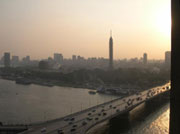
A view of Cairo from the Nile with the Cairo Tower, a free standing TV tower on Gezira Island, in the foreground Source: View of Cairo from the Nile, Central Intelligence Agency

Rivers are essential to the survival of many settlements. Rivers supply transportation and trade routes as well as irrigation, power, and nourishment for the population.

Mountains
Interactive button. Assistance may be required.
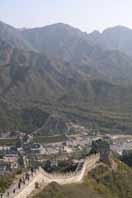
Image of The Juyongguan section of the Great Wall is closest to Beijing, China. A mountain range can be seen in the background. Source: Juyonhgguan, Central Intelligence Agency.

Mountains can be a deterrent for some but also serves as protection from enemies. Most settlements will not be located in mountainous areas unless there is also a reliable source of water present.

Valleys
Interactive button. Assistance may be required.
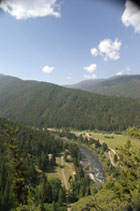
Image of the view of the Gallatin River from Storm Castle Trail, Gallatin, Montana. Source: View of the Gallatin River, Central Intelligence Agency

Valleys provide protection from weather and typically have a river or other water source either running through the middle of them or somewhere close by.

Oceans
Interactive button. Assistance may be required.
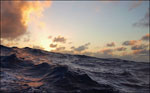
Image of waves on the ocean at sunset Source: Ocean Surface, NASA.

Oceans are very useful for ports of trade. Most cities that are located on the ocean are also located at the mouth of a river for use as a fresh water source.

Extremely Cold Temperatures
Interactive button. Assistance may be required.
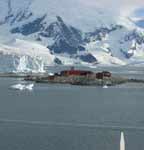
Image of the Argentine Antarctic research station. Source: Argentine Antarctic Research station, central Intelligence Agency.

Extremely Cold Temperatures - locations toward the north or south pole tend to be less populated due to the harsh weather conditions. This is true as you move away from the equator in either direction.

Extremely Hot Temperatures
Interactive button. Assistance may be required.
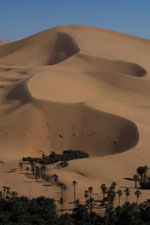
Images of sand dunes beyond an oasis of palm trees in Libya Source: Photo, dunes encroaching, Central Intelligence Agency.

Extremely Hot Temperatures - locations very close to the equator or in very dry, hot desert conditions are less desirable for settlement as it can be difficult to cultivate the land.

Lack of Rainfall
Interactive button. Assistance may be required.
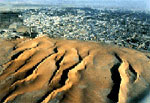
Image of very dry dunes that sit above a city Mauritania. Source: Linear dunes, U.S. Geological Survey.

Lack of Rainfall - settlements that are established near renewable water sources such as rivers and streams also must rely on an adequate amount of rainfall to replenish their water supply. Lack of rainfall results in difficulty cultivating crops as well as inadequate drinking water.

Excessive Rainfall
Interactive button. Assistance may be required.
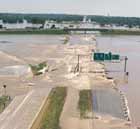
Image of a highway and onramp covered by water. There is a highway sign that is almost at eye-level of the street because of the water. Source: 1993-Flood, U.S. Geological Survey.

Excessive Rainfall - too much rainfall can also result in an area that is difficult to settle. Problems with flooding can have the same effect on a settlement as not enough rainfall.

Interactive exercise. Assistance may be required. Activity 1

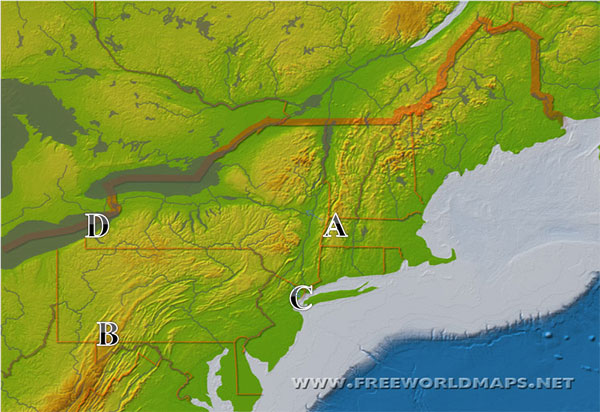
Look at the map below, which area do you think is the best place to establish a settlement? (Choose: A, B, C or D). Why? Record your answers in your Link to Take Notes Tool Tool.

Image of a blank physical map of Northeastern United States. There are letters placed at 4 locations. Adapted from Northeastern U.S Physical, Free World Maps


Open the Megacities.ppt 


Take a look at the map below. It is a physical map of the world. Remember that the purpose of a physical map is to show the physical features (bodies of water, elevation, capital and major cities) of an area.

Interactive exercise. Assistance may be required. Look for characteristics that these cities have in common.

Select one of the countries listed below. Click on the country's link to research information about your selected country and answer the following questions in your Link to Take Notes Tool tool.

  1. Name one important geographic feature of this country.
  2. How does this geographic feature impact the pattern of settlement in this country?
  3. Give at least two examples of how the people of this country interact with their environment?

  • Egypt
  • United Kingdom
  • Iraq
Powered by Create your own unique website with customizable templates.