AP HUMAN GEOGRAPHY
  • Home
  • About
  • Contact
  • Tips For Succes
  • UNIT 1
    • ESPN Model
    • Question of WHERE? >
      • Blog
    • Interpreting Data
    • Distribution
    • Mapping Skills & Geographic Tools >
      • Map Test Review
      • Cool Geographic Tools
      • Latitude and Longitude
      • Map Projections
      • Types of Maps
      • The Big Picture: The Continents and Oceans
    • Thinking About Place >
      • Telling Time Zones
      • Site and Situation of a Place
      • Location of a Place
    • Regions >
      • Exploring Physical Regions
      • Exploring Cultural Regions
      • Human Environment Interaction
      • Environmental Determinism vs. Possibilism
    • Thinking About Scales >
      • Differentiating Scales
      • Globalization
    • Thinking About Connections >
      • Spatial Interactions
      • Diffusion
    • UNIT 1 Review >
      • UNIT 1 Vocabulary
      • UNIT 1 Topics & FRQs
  • UNIT 2
    • Where Is The World's Population Distributed? >
      • Population Density and Resources
      • Population Density
      • Comparison Activity: Population Density and Climate
      • Climate Zones Review
    • Demography and Where Has The World's Population Increase? >
      • 7 Billion and Counting
      • Birth Rates and Death Rates: Population Increase
      • Standard of Living: MDCs vs. LDCs
      • Human Development Index >
        • Human Development Index Project
    • Why Is Population Increasing At Different Rates In Different Countries? >
      • How To Read A Population Pyramid
      • How To Interpret A Population Pyramid
      • Population Pyramid Activity Assessment
    • Population Policies >
      • Lost China Girls Replacement Activity
    • Why Do People Migrate? >
      • Push & Pull Factors
      • Intervening Obstacles
      • Characteristics of Migrants
    • Where Are Migrants Distributed? >
      • Great Migrations Voicemail Project
    • Why Do Migrants Face Obstacles? >
      • Immigration Policies of Host Countries
      • Immigration Issues Today
    • UNIT 2 Review >
      • UNIT 2 Vocabulary
      • UNIT 2 Topics & FRQs
  • UNIT 3
    • Folk vs. Popular
    • Cultural Divergence & Convergence
    • Why Is Folk Culture Clustered? >
      • Isolation Creates Diversity
      • Influence Of The Physical Environment
    • Why Is Popular Culture Widely Distributed? >
      • Diffusion Of Popular Culture >
        • Diffusion Of Culture Through Media
        • Threat To Folk Culture
    • Where Are English Language Speakers Distributed? >
      • Origin and Diffusion Of English >
        • English Colonies
      • Dialects Of British English
      • British English vs. American English
      • US English Dialects
    • Classification Of Languages & Diffusion
    • Why Do People Perserve Local Languages? >
      • Case Study: Hebrew Language
      • Case Study: Gaelic Language
      • Case Study: Icelandic Language
      • Case Study: Multilingual States
    • Global Dominance Of English >
      • Changing Languages
    • World Religions >
      • World Religions Quick Facts
    • Where Are Religions Distributed? >
      • Religion Bodies Project
      • Diffusion Of Religions
      • Holy Places & Calendars
    • Why Do Religions Organize Space In Patterns? >
      • Disposing Of The Dead
      • Religious Settlements
      • Administration Of Religious Spaces
    • Religious Conflicts >
      • Religion vs. Government
      • National Geographic Assignment >
        • Arab-Israeli Conflict
        • Northern Ireland Conflict
        • Tibet Conflict
        • Nigerian Conflict
    • US Ethnicities Distribution >
      • Concentrations Of Ethnicities In The US
      • African American Migration Flows
    • Differentiating Between Race & Ethnicity >
      • Apartheid In South Africa
    • Why Do Ethnicities Clash? >
      • Ethnic Cleansing >
        • Modern Ethnic Conflicts
    • UNIT 3 Review >
      • UNIT 3 Vocabulary
      • UNIT 3 Topics & FRQS
  • UNIT 4
    • Where Are States Located? >
      • Types Of Government Systems
      • Problems Defining States
      • Varying Sizes Of States
    • Development Of State Concept >
      • Colonies >
        • Colonial Practices
    • Where Are Boundaries Drawn Between States?
    • Why Do Boundaries Create Conflict Between States? >
      • Turmoil In The Caucasus Region
      • Stateless Nations
    • Supranational Organizations: EU & UN >
      • NATO & NAFTA
      • OPEC & WTO
      • Latin American Union Project
    • Unit 4 Review >
      • UNIT 4 Vocabulary
      • UNIT 4 Topics & FRQs
  • UNIT 5
    • Where Are Agricultural Regions In LDCs? >
      • Shifting Cultivation
      • Pastoral Nomadism
      • Intensive Subsistence Agriculture
      • Agriculture in LDCs Thinking Questions
    • Where Are Agricultural Regions In MDCs? >
      • Mixed Crop & Livestock
      • Dairy Farming
      • Grain Farming
      • Livestock Ranching
      • Mediterranean Agriculture
      • Commerical Gardening & Fruit Farming
      • Plantations
      • Agriculture In MDCs Thinking Questions
    • Von Thunen Model
    • Hungry Earth: World Food Crisis >
      • Green Revolution
      • Future Of Foods
      • World Food Resources
      • Hunger Games Project
    • Sustainable Agriculture >
      • Dangers Of Non-Sustainable Agriculture
      • Sustainable Agriculture >
        • Saving The Rainforest
    • Eat More Chicken? Beef? or Pork?
    • UNIT 5: Review >
      • UNIT 5 Vocabulary
      • UNIT 5 Topics & FRQs
  • UNIT 6
    • Economic Systems
    • Economic Indicators >
      • Economic Activities
      • Productivity
      • Raw Materials
      • Consumer Goods
    • Social Indicators
    • Demographic Indicators
    • LDCs Face Development Obstacles >
      • How Countries Develop
      • Distribution of MDCs and LDCs >
        • Categorizing Development
        • Interpreting Demographic Data >
          • Levels Of Development Activity 1
          • Levels Of Development Activity 2
          • Levels Of Development Exploration
    • Origins Of Industry
    • Where Is Industry Distributed? >
      • North America Industrial Regions >
        • Maquiladoras Case Study
      • East Asia Industrial Regions
    • Development Theories And Models >
      • Least Cost Theory
    • Industrial Problems >
      • Industrial Poster
    • Why Do Industries Face Problems? >
      • Industrial Problems In MDCs & LDCs
    • UNIT 6 Review >
      • UNIT 6 Vocabulary
      • UNIT 6 Topics & FRQs
  • UNIT 7
    • World Cities
    • Topograpy & Settlements >
      • How Do Resources Influence Settlements?
      • How Do Man-Made Features Influence Settlements?
    • Origin Of Cities
    • Where Did Services Originate? >
      • Origin Of Services
      • Services In Rural Settlements
    • Consumer Service Patterns >
      • Market Area Analysis
      • Rank Size Rule
      • Economic Base Of Settlements
    • Why Do Services Cluster In Downtown?
    • Outside The CBD
    • Why Do Cities Have Problems? >
      • Cause & Effect Practice
    • Inner City Problems
    • Where Are People In Cities? >
      • Concentric Zone Model
      • Sector Model
      • Multiple Nuclei Model
      • Peripheral Model
      • Latin American Urban Model
      • African Urban Model
      • Asian Urban Model
    • UNIT 7 Review >
      • UNIT 7 Vocabulary
      • UNIT 7 Topics & FRQs
  • AP REVIEW
    • Notable Geographers
    • Key Concepts In APHG
    • Decoding APHG
    • FRQ Tips
    • Online Reviews
    • Around The World Reviews
    • Predict Your APHG Exam Score

In this lesson, you will learn about the negative effects of urbanization. As you travel through the activities, think about how this topic connects to your town or city. Do you live in an urban area or a rural area? There are many characteristics that set rural areas apart from urban areas. What is the difference between living in the city and living in the country?

Read the characteristics below and determine if they describe urban or rural.

Interactive exercise. Assistance may be required. Click on the term and drag it to the correct column.

This activity requires a Flash plug-in and is not supported by your browser or device.

Tips for Mobile Device Users


Activity:
Answer the following question . Which do you think is better to live in, an urban area or a rural area? Explain your answer by providing at least three examples.

Urbanization has led to greater exchange of ideas, a wider availability of goods and services from a greater number of merchants, crowded living quarters and higher prices for those homes (think New York City and the high rents), to name a few. But those are just economic and cultural effects of growing cities.

There are environmental effects as well. For instance, as people flock to cities more roads are built which increases the percentage of the city covered in concrete rather than grass. This heats up the area causing cities to have higher temperature than the country. This is illustrated in the graph below.
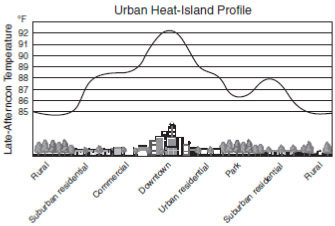
Image of a graph titled Urban Heat-Island Profile. The x-axis is a picture of a labeled landscape of (left to right): Trees (rural); trees and homes (suburban residential); small buildings (commercial); taller buildings (downtown); small buildings (urban residential); trees (park); trees and homes (suburban residential); trees (rural).
Source: Urban Heat-Island Profile, Texas Education Agency.

Often as coastal areas are built up for tourism or housing, wetlands and other wildlife habitats are lost. In the following map, you can see how the wetlands around San Francisco were lost due to increasing urbanization.
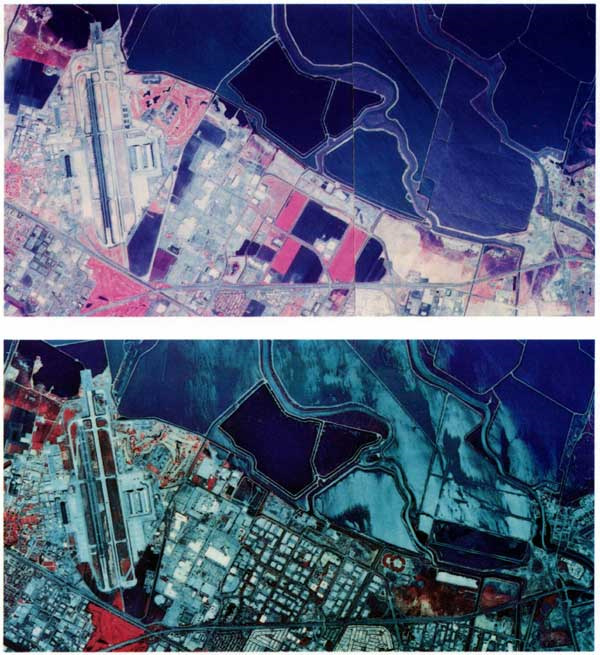
Images of an aerial infrared photo of South San Francisco Bay taken ten years apart.
Source: Coastal Wetlands and Sediments of the San Francisco Bay System, U.S. Geological Survey.

About the photos: These images of the extreme South San Francisco Bay are two-color infrared (CIR) aerial photographs taken ten years apart; these photographs are used to examine changes in the water and on land:

  • Vegetation appears in various shades of red and pink,


Interactive exercise. Assistance may be required. Complete the Venn diagram by dragging each statement into the correct category.

This activity requires a Flash plug-in and is not supported by your browser or device.


The Encyclopedia Britannica defines urbanization as the process by which large numbers of people become permanently concentrated in relatively small areas, forming cities. This growth of urban areas can be positive, but urbanization can lead to many problems.

In this section, you will explore the different effects of urbanization.

Interactive exercise. Assistance may be required. Click on the different elements of the web below to learn about urbanization and its effect on human interaction.

This activity requires a Flash plug-in and is not supported by your browser or device.


Sources for images used in this section, listed clock-wise:

Columbus Fire Department Medic 7, Ibagli, Wikipedia.
South Africa Centurion 58185411, hmvh, Flickr.
Graffiti Pispala, katutaide, Flickr.
Kibera close up, Chrissy Olson, Flickr.
27556659120, tenaciousme, Flickr.
Herald square traffic, Matthias Rhomberg, Flickr.
Debris in the Duke of Northumberland's river, Kendall Bridge, Isleworth, London.
Haze of pollution in Beijing, David Barrie, Flickr.
Delhi Bus Crowded, Wikitravel.
Dhaka streets (Bangladesh), Ahron de Leeuw, Flickr.
Calgary NW Landfill3, D'Arcy Norman, Flickr.

Powered by Create your own unique website with customizable templates.